Swedish Drinking Songs
It is a warm evening in August. The table is covered in crayfish shells, paper lanterns are hanging nearby and someone is wearing a slightly ridiculous hat. A guest taps a glass and calls out the name of a tune. Within seconds the table is singing, some from memory, some from a printed sheet and a few simply humming along. The song lasts less than a minute. Glasses are raised, somebody says skål, and the meal carries on.
That little song is a snapsvisa, and the plural is snapsvisor.
In English, snapsvisor are usually described as Swedish drinking songs. That is a useful translation, although the Swedish word is more specific. A snapsvisa belongs to the toast and, traditionally, to the small serving of spirits Swedes call a snaps. Many of them are short, humorous and written to melodies people already know. That simple formula is one reason the tradition has survived for so long: old songs can be passed on, while completely new lyrics can be sung around a table almost immediately.
A cultural guide in English, based on Sweden's inventory of intangible cultural heritage, Spritmuseum and the other sources listed at the end of the page. The rest of Snapsvisor.eu, including the song collection, is in Swedish.
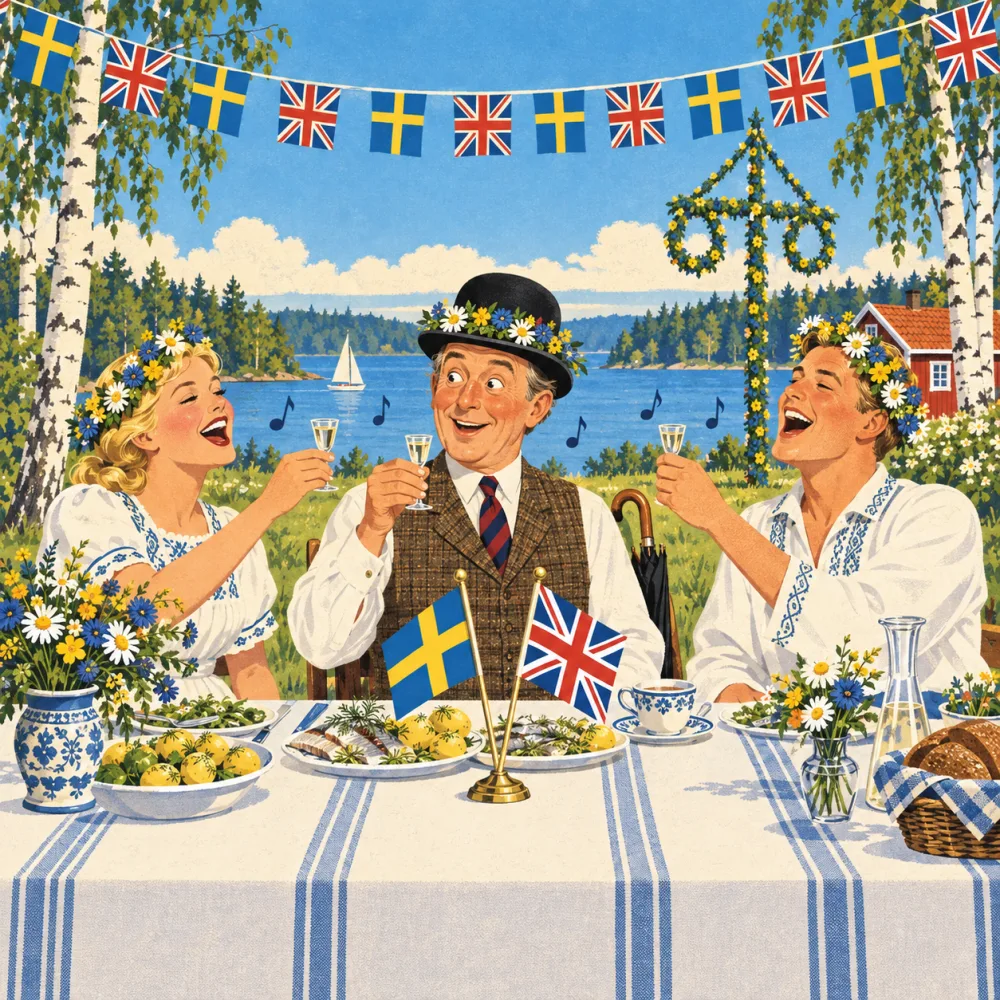
The tradition at a glance
The moment at the table, the song everyone knows and how to take part. Choose a card to jump straight to that section.
What happens at the table
There is no single set of rules followed at every Swedish dinner. Families, student societies and groups of friends all develop their own habits. Still, the basic shape of the moment is easy to recognise.

Someone starts a song. If the lyrics use a borrowed tune, the melody may be announced first, making it easier for everyone to join in. Song sheets are common, especially at larger dinners and organised celebrations. The table sings together, and when the song ends the glasses come up and the group makes the toast. Then everyone goes back to eating and talking.
At some tables there may be several songs during the meal. At others, Helan går may be the only one. What stays the same is that the snapsvisa is communal. It is normally sung with the table rather than performed for it.
At many Swedish dinners, eye contact is also part of the toast. Guests may look at one another as they say skål and again before putting the glass down. This is a common Swedish toasting custom rather than a defining feature of the snapsvisa itself.
Old tunes, new words
Snapsvisor are typically built on a familiar melody with completely new lyrics. It is a practical idea. If everyone already knows the tune, nobody needs to rehearse, and a song written that afternoon for a birthday or a Midsummer dinner can be sung by an entire table that same evening.
Children's songs, Christmas songs, folk tunes, hymns, operetta melodies and popular tunes have all been reused in this way. Two examples an English speaker may recognise:
- Blinka lilla stjärna, the Swedish Twinkle, Twinkle, Little Star
- Imse vimse spindel, the Swedish version of Itsy Bitsy Spider
The lyrics themselves can be about almost anything connected to the occasion: the snaps, the food, a guest, the host, the weather or the fact that somebody's glass is already empty. Wordplay, mild nonsense and deliberately silly rhymes are all part of the form.
Some songs are written for one particular evening and disappear afterwards. Others find their way into songbooks and are sung for generations. The collection on Snapsvisor.eu is sorted by melody, so you can browse the melodies and see which songs have been written to each of them. The pages are in Swedish.
Sources: Levande kulturarv on snapsvisor and Spritmuseum on drinking songs.
Helan går, the song almost everyone knows
If you learn the name of just one snapsvisa, make it Helan går. It is Sweden's best-known snapsvisa, and it is often the first song sung when snaps is served at a traditional festive meal.
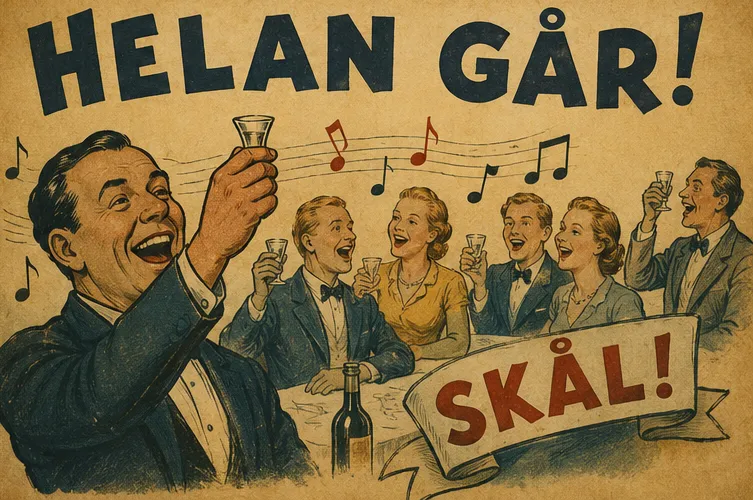
The title comes from an older habit of giving the different snapsar in a meal their own names. The first was helan, roughly "the whole one". The second was halvan, "the half one". The third was tersen.
Song researcher Christina Mattsson has described helan and halvan as names that appeared in the eighteenth century, with the rest of the sequence developing later in student circles during the nineteenth century. Snapsvisor.eu has a separate Swedish guide to the order of the snapsar and their names.
The traditional text is short:
Helan går,
sjung hopp falleri faderallan lej.
Helan går,
sjung hopp faderallan lej.
Och den som inte helan tar,
han inte heller halvan får.
Helan går!
(everyone drinks)
Sjung hopp faderallan lej.
A rough English explanation would be:
The first one goes down,
sing hop fol-de-rol la-la-lay.
The first one goes down,
sing hop fol-de-rol lay.
And if you skip the first one,
there is no second one for you.
The first one goes down!
Sing hop fol-de-rol lay.
The nonsense phrase falleri faderallan lej has no literal meaning. It works like a singing refrain, similar to fa-la-la in English. The wording varies a little from table to table, and this is the version used on the Swedish song page for Helan går, which also has the second verse, Halvan går.
The exact origin of the song is uncertain. It is usually put at roughly 150 years old, with an early form of the melody traced to the nineteenth century, and to the 1840s operetta Modehandlerskan in particular.
There is also a well-known story from the 1957 Ice Hockey World Championship in Moscow. After Sweden won the title, the team sang Helan går when the national anthem was called for.
The pronunciation is roughly HAY-lahn gawr, although Swedish vowels do not map neatly onto English ones. If you want to get it right, listen to a Swedish recording once before the dinner.
Sources: Spritmuseum on the history of snapsvisor, Christina Mattsson in Forskning & Framsteg and Uppslagsverket Finland.
Snaps: a way of drinking rather than one particular drink
English speakers often assume snaps is the name of a specific spirit, but the word mainly refers to how the drink is taken rather than to one fixed type of alcohol.
Traditionally, what is served is often brännvin, a broad Swedish term for spirits that may be flavoured or unflavoured. Aquavit, or akvavit in Swedish, is one particular type of flavoured brännvin, and under EU rules it must be flavoured primarily with caraway and/or dill. So aquavit is often served as snaps, but snaps and aquavit are not the same thing.
The English word schnapps is also best avoided as a direct translation. The words are related historically, but schnapps can refer to quite different styles of drink in English-speaking countries. Keeping the Swedish word snaps and explaining it is clearer.
A snaps also does not have to be swallowed in one go. Systembolaget's own guidance on pairing snaps with food recommends smaller sips rather than automatically drinking the entire glass at once.
Sources: Systembolaget on snaps, brännvin and akvavit, Regulation (EU) 2019/787 and Systembolaget on snaps with food.
When you will hear snapsvisor
Swedes do not sing drinking songs every time alcohol is served. Snapsvisor belong mainly to particular festive meals, traditions and social settings.

Midsummer, traditionally celebrated in late June, is the best-known example. Snapsvisor appear alongside pickled herring, new potatoes and other classic dishes, and both snaps and drinking songs are part of the traditional Midsummer meal. The most sung ones are collected on the Swedish page Snapsvisor till midsommar.
The crayfish party, or kräftskiva, is the other setting most strongly associated with the songs. These late-summer parties often include crayfish, paper decorations, festive hats, lanterns, snaps and communal singing. The Swedish page Snapsvisor till kräftskivan has the songs.
Christmas and Easter bring the traditional smörgåsbord, where snaps and drinking songs can also have their place.
Student dinners have a long connection with the tradition, and snapsvisor are still part of student life at Swedish universities today. Different universities and student organisations have their own customs, songbooks and terminology, and formal dinners may include several rounds of communal singing.
Weddings, milestone birthdays, anniversaries and other organised dinners may include snapsvisor too, especially when somebody has written a new song for the occasion.
The common denominator is not alcohol alone. It is the combination of food, company, tradition and a shared toast.
Sources: Visit Sweden on Midsummer, Visit Sweden on the crayfish party and Levande kulturarv on snapsvisor.
Where the tradition comes from
People have sung in connection with drinking for centuries, and Sweden did not invent the drinking song. The background of snapsvisor reaches back to older, including medieval, drinking-song traditions, and the form recognisable today developed further during the eighteenth and nineteenth centuries, with student culture becoming especially important. The modern snapsvisa became established particularly strongly in university towns and middle-class dinner settings during the second half of the nineteenth century.
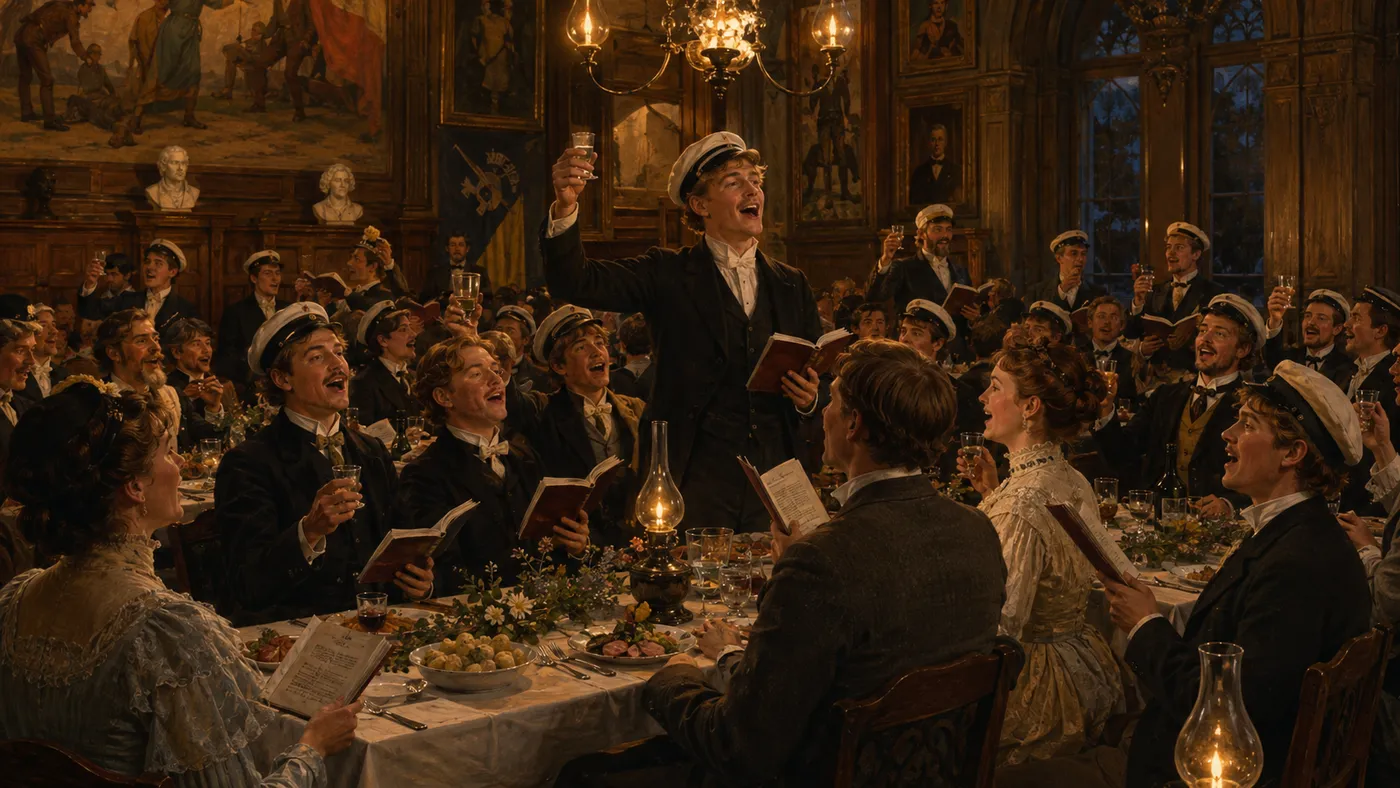
That environment suited the form perfectly. Many people gathered around one table, everyone knew the same melodies and new lyrics could spread quickly from one dinner to another. During the early twentieth century, the songs continued to spread at the same time as Swedish alcohol policy became more restrictive and the motbok, a ration book for buying spirits, became part of everyday life.
Many cultures sing while drinking, so that is not what sets Sweden apart. What is distinctive is this particular form: short communal songs connected to the toast, very often using new lyrics to familiar melodies. Christina Mattsson has pointed to Sweden and Swedish-speaking Finland as the places where the model has continued particularly strongly, and the Swedish inventory of intangible cultural heritage describes the tradition as found throughout Sweden and in Swedish-speaking Finland.
It is also a tradition that never stopped developing. Spritmuseum began collecting snapsvisor in 1992 and today holds more than 12,000 songs in its archive. Since 1995 the museum has organised a Swedish championship for newly written snapsvisor, and new songs are still being written every year.
Sources: Levande kulturarv on snapsvisor, Spritmuseum on the history of snapsvisor, Christina Mattsson in Forskning & Framsteg and Spritmuseum on the championship for new snapsvisor.
Joining in as a guest
You do not need to speak Swedish to take part. Most snapsvisor are short, many use familiar melodies and song sheets are common at larger gatherings. If you do not know the words, follow the sheet, sing what you can and hum the rest.
Some student organisations with large international communities have even produced English explanations of their songs. The Student Union of Åbo Akademi University in Finland is one example. There are also snaps songs written or adapted in English, including an English-language booklet from Spritmuseum with eight songs, among them a version of Helan går titled The Whole Goes. Still, many international guests simply join in with the Swedish version.
You also do not have to drink alcohol. The song and the toast are the shared part of the tradition, and what is in your glass is a personal choice. Water, a soft drink or an alcohol-free alternative works perfectly well.
If you are curious about Swedish toasting etiquette, Snapsvisor.eu also has a Swedish guide to the ten golden rules of the skål.
Sources: the Student Union of Åbo Akademi University and Spritmuseum's English song booklet.
Snapsvisor.eu has a tool for putting together a song booklet for your guests, on their phones or as a printed PDF. The tool and the songs are in Swedish.
A few Swedish words worth knowing
| Swedish | Meaning |
|---|---|
| snaps | A small serving of spirits, traditionally taken with food |
| snapsvisa | A short communal drinking song connected to a snaps and toast |
| snapsvisor | Plural of snapsvisa |
| skål | "Cheers", and also the toast itself |
| nubbe | An informal Swedish word for a snaps |
| brännvin | A broad Swedish term for flavoured or unflavoured spirits |
| akvavit | Aquavit, a specific type of flavoured brännvin |
| helan | The traditional name of the first snaps |
| halvan | The traditional name of the second snaps |
| tersen | The traditional name of the third snaps |
| kräftskiva | Crayfish party |
| midsommar | Midsummer |
| sånghäfte | Song booklet or song sheet |
Swedish has many more words for a snaps than nubbe. They are collected, with a dictionary source for each, in the Swedish guide Snapsens många namn.
Why the songs keep coming
The snapsvisa survives because it asks very little of the people singing it. You do not need to be a musician, you do not need to know the song beforehand, and you may not even know the language particularly well. A familiar tune and a few lines on a song sheet are often enough.
That makes the form unusually easy to renew. Old melodies get new words, new songs are added to old songbooks, and a song written for one dinner may disappear the next day while another is copied, shared and eventually becomes part of the tradition.
And every year, at tables around Sweden, somebody starts Helan går and the rest of the group already knows what happens next.
From the guide to the songs
The song collection and the other guides on Snapsvisor.eu are in Swedish, but the lyrics are short and the melodies are named on every song page.
Frequently asked questions
Sources and further reading
Below are the most important sources behind the cultural and historical statements on this page. Several of them are in Swedish. Advice about how to take part as a guest is editorial guidance from Snapsvisor.eu.
The tradition
- Institute for Language and Folklore (Institutet för språk och folkminnen), Levande kulturarv, Snapsvisor (drinking songs): Sweden's inventory of intangible cultural heritage. Main source for the snapsvisa as a song tied to the toast, new lyrics to familiar melodies, the smörgåsbord at Christmas and Easter, student culture, the older drinking-song background and the tradition in Sweden and Swedish-speaking Finland
- Spritmuseum, Drinking songs: the basic form, short songs written to melodies people already know
- Spritmuseum, The History of Snapsvisor: Helan går as the best-known snapsvisa, its age and melody, the 1957 story from Moscow, the university towns of the nineteenth century, the motbok years, the archive of more than 12,000 songs and the championship
- Forskning & Framsteg (2013), Helan går, men bara på svenska: interview with song researcher Christina Mattsson, on the age of the names helan and halvan and on Sweden and Swedish-speaking Finland as the home of the form (in Swedish)
- Uppslagsverket Finland, snapsvisa: connects the melody of Helan går with the 1840s operetta Modehandlerskan (in Swedish)
- Spritmuseum, SM i nyskrivna snapsvisor: the Swedish championship for newly written snapsvisor (in Swedish)
Snaps, brännvin and aquavit
- Systembolaget, Snaps, brännvin och akvavit: snaps as a way of drinking rather than one type of spirit, and the difference between brännvin and akvavit (in Swedish)
- Regulation (EU) 2019/787, Annex I, category 24, Akvavit or aquavit: the requirement that aquavit is flavoured primarily with caraway and/or dill
- Systembolaget, Snaps till mat: the advice to take smaller sips with food (in Swedish)
The occasions
- Visit Sweden, Midsummer in Sweden, like something from another world: the traditional Midsummer meal with pickled herring, new potatoes, snaps and drinking songs
- Visit Sweden, Crayfish party, and Visit Sweden Travel Trade, Festive foods and traditional treats: the crayfish party with paper decorations, hats, lanterns, snaps and communal singing
Songs in English
- The Student Union of Åbo Akademi University, Engelska beskrivningar på snapsvisor: English descriptions of snaps songs (PDF)
- Spritmuseum, Drinking songs: English song booklet with eight songs, among them The Whole Goes (PDF)
Further reading on Snapsvisor.eu (in Swedish)
- Vad är en snapsvisa?: what defines a snapsvisa, and how it differs from other drinking songs
- Snapsvisans historia: the history, from Bellman and the student dinners to Moscow 1957
- När sjunger man snapsvisor?: the occasions, from Midsummer and crayfish parties to weddings and student dinners
- Skålens 10 gyllene regler: ten golden rules of the toast, eye contact and older Swedish toasting etiquette
- Snapsarnas ordning: the 18 classic names of the snapsar, from Helan and Halvan onwards
- Snapsens många namn: the many Swedish words for a snaps, with a dictionary source for each